August 13, 2026
Attackers Are Working Around the Clock, So Are We: FoxRadar360

How Ransomware Destroyed KNP Logistics After 158 Years of Operations
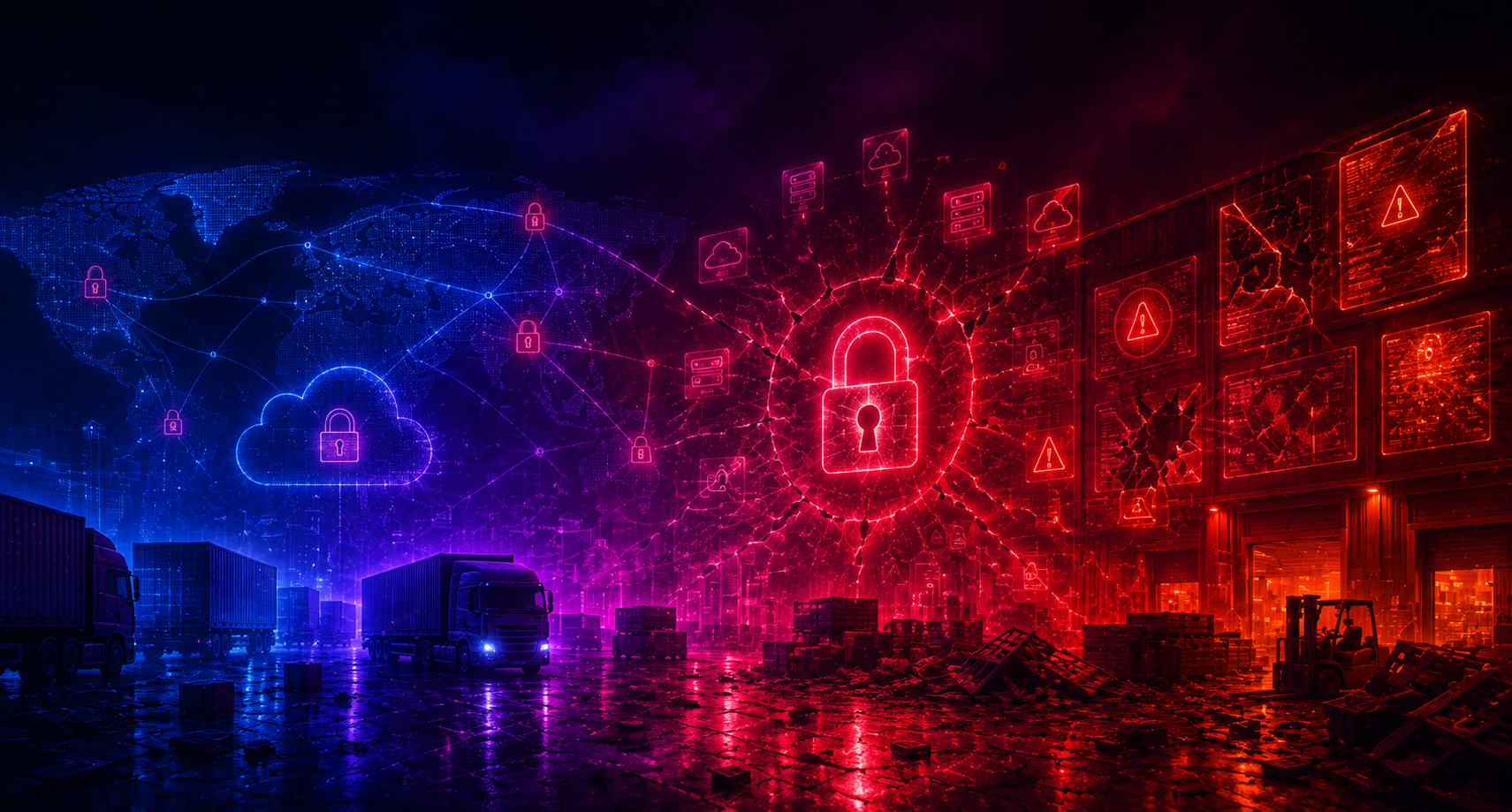
Companies fail for all kinds of ordinary reasons: bad markets, bad debt, bad timing. Very few fail because someone guessed a password.
KNP Logistics Group traced its history to 1865, operating through two world wars, oil shocks, recessions, and the complete transformation of British freight. By the time of the attack it employed around 900 people across seven depots, ran hundreds of trucks, and turned over close to £100 million a year. Its best-known brand, Knights of Old, was a fixture on UK motorways. The Cyber ExpressSecureW2
In June 2023, the Akira ransomware group brute-forced an employee's password and, with no multi-factor authentication in place, moved into the network without difficulty. On 25 September 2023, KNP entered administration. Roughly 730 people lost their jobs, with about 170 preserved through the sale of one subsidiary. Cyberonix Blog + 2
The case matters not because it was sophisticated, but because it was not. Every control that would have changed the outcome was available, well understood, and unglamorous. This is a breakdown of what happened, why the recovery failed, and what a mid-sized operator should take from it.
The sequence is worth walking through carefully, because each stage represents a decision point that existed for the defenders.
KNP later concluded that Akira gained access through brute forcing, using software that makes very large numbers of password guesses against an account. There was no zero-day exploit, no elaborate social engineering campaign, and no insider. SecureW2
Multi-factor authentication was not enabled on remote access systems, which meant a correct password guess produced working access rather than a blocked login attempt. That single configuration gap converted a routine, high-volume attack technique into a successful intrusion. SOS Ransomware
Brute-force and credential-spraying attacks against internet-facing remote access run continuously against every organization with an exposed login page. They succeed only where the password is weak and the second factor is absent. Both conditions were present.
Once inside the compromised account, the attackers extended access laterally and reached production servers without triggering alerts. This is the part of the story that gets least attention and deserves the most. SpecopsSoft
An intrusion that begins with one account has to travel. That travel generates telemetry: authentication patterns that do not match the account's history, enumeration of directory objects and file shares, credential access attempts, and administrative activity from an account that has never performed it. Every one of those signals existed. None of them reached anyone in a position to act.
The company's director later acknowledged that more capable security monitoring might have detected the intrusion. That is the crux of the case. The failure was not that an attacker got in. It was that nobody saw them once they were inside. SecureW2
This is the gap that continuous monitoring exists to close, and it is worth assessing honestly whether your own environment would surface lateral movement from a single compromised account. Establishing that baseline with FoxRadar360 is a considerably cheaper exercise than discovering the answer during an incident.
KNP's backups were either encrypted or destroyed, which made recovery impossible. This is the step that separates a serious operational incident from a terminal one. SOS Ransomware
Ransomware operators do not encrypt first and hope. They locate backup infrastructure, verify they can reach it, and destroy it before deploying the payload. Backups reachable with domain credentials are not a recovery plan. They are additional data waiting to be encrypted.
The ransom note left by Akira did not name a figure, but negotiators estimated a demand of up to £5 million, which KNP could not pay. The company held a £1 million cyber insurance policy, which proved insufficient. WeightmansWeightmans
Payment would not necessarily have helped. Decryption after payment is unreliable, slow at scale, and does nothing about data already stolen. But the arithmetic here is instructive: the demand exceeded both the available cash and the insurance cover, which removed even the bad option from the table.
The attack removed the ability to invoice customers and to report financials to creditors, which drove the company into insolvency. Corrupted financial records left KNP unable to meet reporting obligations to lenders or delivery obligations to customers. SOS RansomwareThe Cyber Express
This is the detail most technical post-mortems skip. The company did not fail because files were encrypted. It failed because a haulage business that cannot invoice, cannot report to its lenders, and cannot tell customers where their freight is has no functioning commercial operation, and creditors do not wait.
Drivers were still owed weeks of wages afterward, and former staff described losing homes, cars, and marriages in the aftermath. The human cost of a security failure is rarely captured in an incident report. SecureW2
A common reaction to this case is that KNP was unlucky. The targeting pattern suggests otherwise.
Ransomware affiliates pursue organizations large enough to afford a payment and disruption-sensitive enough to feel urgency, without a mature security operation to interrupt them. A £100 million logistics group with 900 staff and a small IT function fits that profile precisely.
Logistics compounds it. Freight operations tolerate downtime poorly because obligations are contractual and immediate, and the sector runs on tightly coupled digital systems for planning, tracking, warehousing, and billing. Operators know this, which is why transport and distribution firms continue to be hit disproportionately.
KNP reportedly adhered to international data security standards and carried cyber insurance, and still could not recover. This deserves emphasis for anyone using certification as a proxy for resilience. Insurance Journal
Standards verify that controls exist and are documented. They do not verify that multi-factor authentication is enforced on every remote access path, that backups are genuinely isolated from production credentials, or that anyone is watching the alert queue at two in the morning. Those are operating conditions, and they are what determine outcomes.
A policy pays out after the fact and on the policy's terms. It does not restore encrypted data, resume operations, or satisfy a lender demanding current financials. Organizations treating insurance as their ransomware strategy are insuring against a loss they will still be unable to survive operationally.
Every one of these was available in 2023, and none required exotic technology.
The single highest-value control in this case. A brute-forced password against an account protected by a second factor produces a failed login and an alert, not access.
Push notifications and one-time codes are better than nothing but are defeated routinely by fatigue attacks and real-time relay phishing. Origin-bound authentication using passkeys or FIDO2 hardware cannot be relayed, because the credential simply will not respond to a domain other than the one it was registered against.
Deploy it to remote access and administrative accounts first, and close the fallback paths as you go. An account with a passkey and an active SMS recovery option is protected at the strength of the weakest available method.
The intrusion had time to travel from one account to production servers. That window was the opportunity.
The signals worth instrumenting specifically: authentication from an account to systems it has never touched, bursts of directory or share enumeration, credential access attempts against the local security subsystem, service accounts authenticating interactively, and administrative group membership changes outside a change window.
These fire during the middle stages of nearly every ransomware intrusion, which makes them the most valuable detection investment available for organizations in this size bracket.
Ransomware deployment is deliberately timed for Friday evenings, holidays, and the early hours of weekends, because encryption that starts at 11 p.m. on a Friday may run uninterrupted until Monday morning.
A detection that fires into an unmonitored queue has not detected anything meaningful. For organizations without the headcount to staff analysts around the clock, which describes most mid-sized operators, managed detection and response delivers the coverage without building the team. Reviewing what that would look like against your specific estate is a conversation worth having with FoxRadar360 before you need it rather than after.
Backups reachable with domain credentials will be found and destroyed. The requirements are specific: immutable storage that cannot be deleted within its retention window, credentials entirely separate from the production domain, and at least one logically isolated or offline copy.
Restoration must also be tested at realistic scale. Backups that exist but take three weeks to restore do not prevent an operational crisis, and three weeks without invoicing is enough to end a business with normal working capital.
Shadow copy deletion, security service tampering, backup repository access from unexpected accounts, and mass installation of remote management tooling all precede encryption, often by less than an hour.
These belong in an immediate-response category with pre-approved containment authority, not in a queue for morning triage. The authority to isolate a host and disable an account at 3 a.m., agreed in writing before an incident, costs nothing and directly determines how much of an estate gets encrypted.
Flat networks let one foothold reach everything. Separating backup infrastructure, financial and ERP systems, and operational platforms from general user networks limits the blast radius even when initial access succeeds.
For KNP, the systems that mattered most commercially were the ones that ended the business: invoicing and financial reporting. Those deserve the strongest isolation, not the same treatment as a general file share.
If the case prompts action, these are the steps that reduce comparable risk fastest.
Audit every internet-facing authentication path. VPN concentrators, remote desktop gateways, webmail, and any administrative portal. Confirm multi-factor authentication is enforced without exception and that legacy protocols bypassing it are disabled.
Verify backup isolation, not backup existence. Test whether a compromised domain administrator account could delete or encrypt your backups. If the answer is yes, that is your most urgent finding.
Run a restore test at full scale. Measure how long it actually takes to restore your invoicing and financial systems, then ask whether the business survives that period without them.
Confirm someone would see a 2 a.m. alert. Not whether alerts are generated, but whether a human is positioned to triage and act on them at the hours attackers choose.
Document containment authority. Which actions require no approval, who decides on broader ones, and how they are reached out of hours.
Check what your insurance actually covers. Limits, exclusions, notification requirements, and whether the sum insured bears any relationship to a realistic demand and recovery cost.
The KNP case is not a story about advanced adversaries. The attackers did not need a sophisticated phishing campaign or a zero-day exploit. They needed a guessable password on a system without a second factor, and an environment where movement toward production servers produced no response. EasternEye
Three failures compounded into a terminal outcome. Access control failed, which let an attacker in. Detection failed, which let them move freely to the systems that mattered. Recovery failed, because backups sat within reach of the same credentials the attacker had obtained. Any one of those working would likely have produced a serious incident rather than the end of a company founded in 1865.
The uncomfortable lesson for anyone running a mid-sized operation is that KNP was not careless in the way the headlines imply. It held certifications and carried insurance, which is more than many comparable firms manage. What it lacked was enforcement of multi-factor authentication on remote access, monitoring capable of surfacing lateral movement, and backups that an attacker with domain credentials could not destroy.
Those three things are not expensive relative to what they protect. They are simply unglamorous, and they tend to be deferred until something forces the issue. For 730 people in Kettering, the forcing event arrived in June 2023.
To review whether an intrusion starting from a single compromised account would be visible in your environment, and whether your backups would survive it, start a conversation with the team at FoxRadar360.
Let FoxRadar360 transform your business into a secure, monitored, and threat-resilient operation. Schedule your SOC demo in seconds, simple and stress-free.