
August 13, 2026
Attackers Are Working Around the Clock, So Are We: FoxRadar360

SaaS Supply Chain Disasters of 2026: Major Breaches, Risks and Lessons Learned
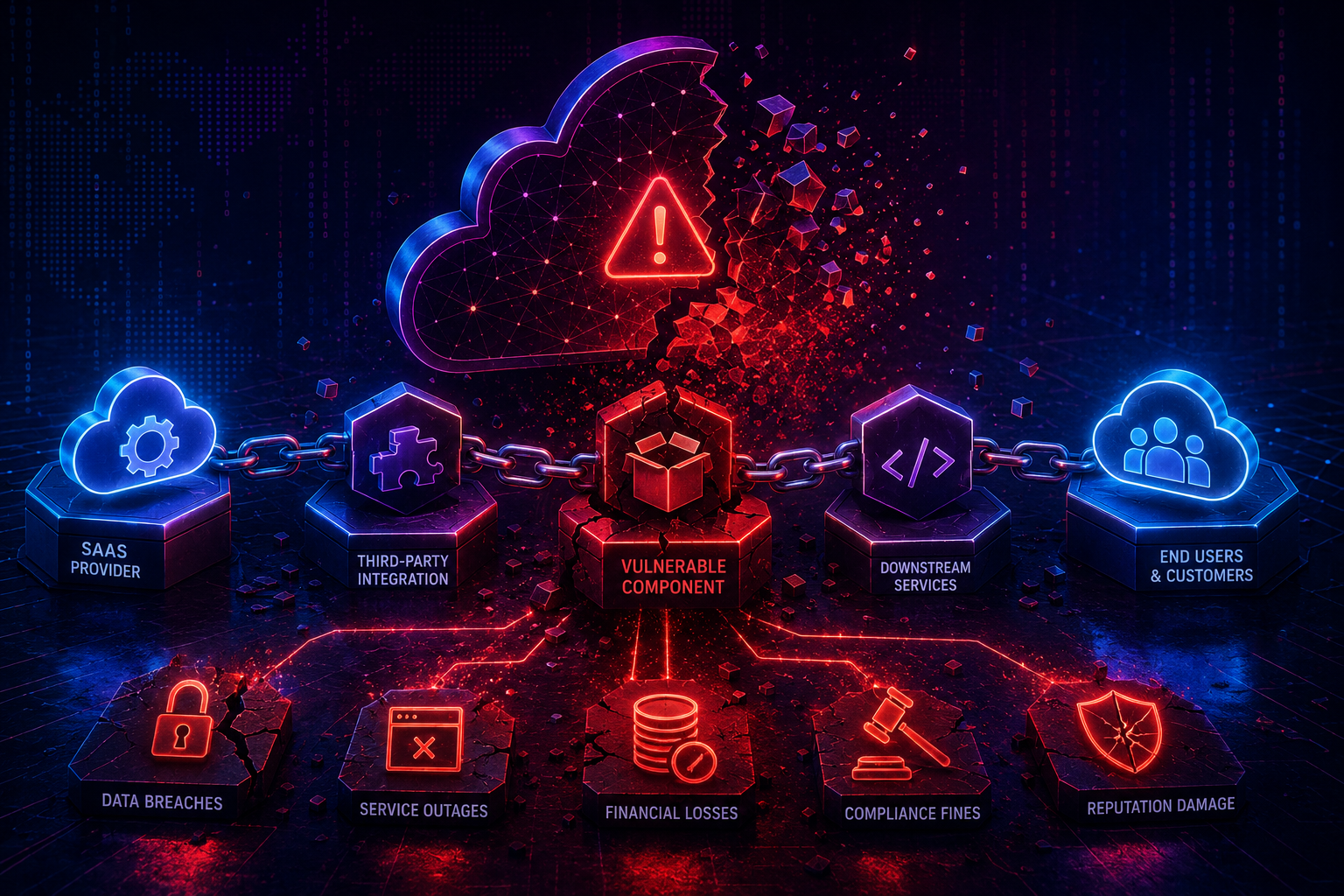
For most of the last decade, supply chain security meant software supply chain security. Watch your dependencies, verify your build pipeline, sign your artifacts. That framing is now incomplete in a way that has cost organizations a great deal this year.
The 2026 pattern looks different. An attacker compromises a vendor you have never thought hard about, takes the OAuth tokens that vendor holds into your environment, and quietly queries your data through an integration your security team approved once and never reviewed again. There is no malicious code, no failed login, and often no sign-in event at all. The activity looks exactly like the automation it is impersonating, because it is running on credentials that were legitimately issued.
One of the defining patterns in the biggest supply chain attacks of 2026 is that a trusted third party holds the keys, and the downstream victim never sees the breach coming. This year has produced enough examples to establish that as a rule rather than an observation.
The economics are straightforward. Supply chain intrusions scale efficiently, because one compromised vendor can propagate to hundreds or thousands of customers, and that force multiplier makes these campaigns attractive to nation state actors seeking access and to criminal groups chasing quick monetization.
What makes SaaS particularly attractive is that the access is pre-authorized and persistent. OAuth refresh tokens frequently do not expire. Integration scopes are often granted far broader than the function requires. And crucially, the traffic generated by a compromised integration is indistinguishable from normal operation.
The visibility gap is well documented. A Cloud Security Alliance survey of 420 security professionals found that 58 percent of organizations struggle to enforce least privilege access across their SaaS integrations and 46 percent lack adequate visibility into non-human identities such as OAuth connected applications.
That second number is the one worth sitting with. Nearly half of surveyed organizations cannot enumerate the machine identities that hold standing access to their data. Teams that engage FoxRadar360 almost always find their actual integration inventory is larger than their documented one, frequently by a wide margin.
The clearest illustration of cascade risk this year came through an analytics vendor.
Threat actors who self identified as ShinyHunters compromised and stole authentication tokens in April 2026 from Anodot, which characterizes itself as an AI enhanced business analytics service, and reportedly used those tokens to exfiltrate corporate data from large databases including Google BigQuery.
The downstream victim list grew for weeks. The Anodot supply chain compromise produced confirmed breaches at Vimeo affecting 119,000 users, Rockstar Games affecting 78.6 million records, and Zara and Inditex affecting 197,000 people, with further downstream victims likely still emerging.
Anodot had authenticated, legitimate access to hundreds of Snowflake environments, and every one of those organizations had a blind spot they did not know about.
The structural lesson is uncomfortable but simple. Each of those downstream organizations had presumably assessed Anodot at procurement, found it acceptable, and moved on. None of them had a mechanism to detect that vendor's credentials being used by someone else. Vendor access is often indistinguishable from internal access.
The second major storyline of 2026 inverted a comfortable assumption, which is that security vendors are better defended than their customers.
Between March 19 and March 27, a group known as TeamPCP systematically injected credential harvesting malware into four widely used open source projects, beginning on March 19 with Trivy, Aqua Security's vulnerability scanner, compromised through its binary, GitHub Actions workflow, and container images, followed on March 23 by Checkmarx's Infrastructure as Code scanner KICS, hit via its GitHub Action and OpenVSX extension.
The targeting was deliberate. Rather than targeting ordinary software packages, they went straight for the security toolchain: the vulnerability scanners, static analysis tools, password managers, and AI gateways that already hold the keys to every secrets vault on a developer's machine.
Post compromise behavior showed real operational discipline. Once secrets were validated, TeamPCP began methodical discovery across victim AWS environments, enumerating IAM users and roles, EC2 instances, Lambda functions, RDS databases, S3 buckets, and Route 53 hosted zones, with particular focus on ECS, while AWS Secrets Manager was enumerated and catalogued for bulk exfiltration. Using stolen GitHub Personal Access Tokens, the attackers created pull requests containing malicious workflows that executed in the context of targeted repositories, giving access to runtime secrets and environment variables.
The propagation mechanic is the part that should worry defenders most. The threat group used CI/CD secrets obtained in one repository breach to gain access to other organizations' repositories, repeating the cycle several times throughout the campaign. The entire cascading multi-phase attack started with a single unrevoked credential stolen from Trivy's CI pipeline.
The campaign reached further into the security industry through the spring. In May 2026, Trellix disclosed a source code compromise linked to the same TeamPCP supply chain activity that had already impacted other security and development vendors, with the attack targeting GitHub environments. The campaign ended with LAPSUS$ leaking 96 gigabytes of private Checkmarx source code to their dark web portal.
Detection failed in a specific and instructive way. Static analysis and domain reputation tools failed entirely because the malicious code was injected into trusted signed actions and the exfiltration domain was newly registered.
The Salesforce OAuth abuse campaign that began in 2025 did not end. It industrialized.
In campaigns observed between mid-2025 and mid-2026, Microsoft identified threat actor activity with tradecraft commonly associated with ShinyHunters, including voice phishing and supply chain compromise, targeting SaaS applications such as Salesforce instances, with threat actors abusing trusted OAuth relationships for unauthorized access, data exfiltration, and persistence.
The wave structure is worth understanding because it shows compounding. In August 2025 Salesloft Drift integration OAuth tokens were stolen, enabling unauthorized access to roughly 760 downstream Salesforce customer organizations. In November 2025 Gainsight token abuse cascaded to more than 200 Salesforce instances, prompting Salesforce to revoke OAuth access. In January 2026 a vishing campaign targeted enterprise SSO environments, including Okta customers, capturing credentials and MFA codes.
A third integration fell mid-year. In June 2026, exploitation of a legacy credential at Klue enabled attackers to push malicious code, harvest OAuth tokens, and access sensitive data from Salesforce and Gong environments, impacting companies including Huntress and Recorded Future. Klue confirmed the breach after attackers used compromised legacy credentials to access its integration environment and obtain OAuth tokens connected to customer platforms.
A separate path exploited platform configuration rather than a vendor. In March 2026, Salesforce issued a security advisory warning of a known threat group exploiting misconfigurations in Salesforce Experience Cloud, with the actors claiming responsibility and warning approximately 400 victim companies to pay or face data leaks, using a modified version of a Chrome extension alongside a custom scanning tool.
What ties these together is detection evasion by design. Threat actors performed discovery, bulk data queries, and mass exfiltration of sensitive CRM records including accounts, contacts, and service case data without generating traditional sign-in anomalies.
Getting SaaS telemetry into monitoring so that this activity produces an alert rather than a post-incident finding is the single highest value change most organizations can make here. FoxRadar360 helps teams extend detection coverage into SaaS platforms where native logging exists but has never been collected or correlated.
One incident this year deserves separate attention because it points at where the next wave is heading.
A breach at Vercel was caused by an OAuth supply chain compromise via a Lumma Stealer infection at Context.ai, where one employee granting broad Workspace permissions to a third party AI tool gave attackers an inherited trust path into the company. The breach was not discovered by the security team; it was discovered when the attacker chose to monetize publicly.
A forgotten SaaS integration can easily become the pivot point for downstream compromise.
The AI tooling boom has produced an enormous volume of new OAuth grants, frequently authorized by individual employees experimenting with productivity tools, frequently requesting broad scopes over mail, documents, and calendars. Most of those grants have never been reviewed. Many were made to companies that did not exist eighteen months ago and have no meaningful security program.
The OAuth graph is now the new perimeter, and most companies have no inventory of which third party apps their employees have authorized.
Strip away the specifics and the same four conditions appear repeatedly.
Standing credentials that never expire. Refresh tokens and CI secrets persist indefinitely unless someone deliberately rotates them, and in the TeamPCP case a single unrevoked credential seeded an entire cascading campaign.
Scopes far broader than function. Integrations routinely hold read access to entire objects when they need a handful of fields, and build pipelines routinely hold credentials to production when they need access to a registry.
No monitoring of non-human identity. Organizations that alert on anomalous human logins frequently have no baseline whatsoever for what normal API volume from a given integration looks like.
Vendor security treated as a procurement checkbox. A questionnaire answered at contract signing tells you nothing about the vendor's posture eighteen months later, which is when these compromises actually happened.
The remediation work is unglamorous and effective.
Enumerate every connected application, integration, and OAuth grant across every major SaaS platform you operate, including grants made by individual users rather than administrators. Assign each one a current business owner. Revoke anything without one.
Review granted scopes against actual functional need and reduce anything holding full data access without a documented reason. Where the platform supports it, restrict integrations to defined IP ranges and enforce token lifetimes rather than accepting perpetual refresh tokens.
Restrict who can authorize new applications. Moving OAuth consent from a user level permission to an administrative approval workflow is the single most effective preventive control available against this entire attack class, and it costs nothing but process friction.
Then make it recurring. An inventory done once decays immediately. Quarterly review with automated discovery between reviews is the minimum viable cadence.
Because these attacks generate no authentication anomalies, detection has to focus on what the integration does rather than how it authenticated.
Baseline normal API call volume per integration and alert on deviation rather than on absolute thresholds, since attackers in these campaigns deliberately started small before escalating. Alert on any new connected application authorization. Alert on bulk export operations and on query patterns that touch objects the integration has never touched before. Alert on integration activity originating from infrastructure inconsistent with the vendor's normal source ranges.
Ship SaaS audit logs to external storage on a retention schedule long enough to support retrospective investigation. Several of this year's incidents were disclosed months after the access window, and organizations with 30 day retention could not scope their own exposure.
Procurement controls need to reflect what actually failed this year.
Require breach notification timelines in contract, specified in hours rather than left to the vendor's discretion. Require that vendors disclose sub-processors, since your fourth party exposure is invisible otherwise. Require support for scoped, short lived credentials rather than perpetual tokens, and make that a technical evaluation criterion rather than a policy statement.
Tier vendors by the access they hold rather than by contract value. A small analytics vendor with read access to your data warehouse carries more risk than a large vendor with none, and most vendor risk programs get this exactly backwards.
Maintain a current map of which third parties hold which regulated data, because you will need it for notification obligations under time pressure and reconstructing it during an incident is not feasible.
Structuring that tiering around actual technical access rather than commercial relationship is where FoxRadar360 helps organizations rebuild third party risk programs that reflect the 2026 threat model rather than the 2019 one.
Assume the notification comes from outside. In several of this year's incidents, downstream victims learned of exposure from the vendor, from a researcher, or from the attacker's leak site.
Have a predetermined runbook: which integration to disable, which tokens to rotate and in what order, which logs to pull and over what window, who owns customer notification, and what your regulatory clock looks like. Rehearse it against a scenario where the compromised party is a vendor rather than your own network, because the response differs substantially. You cannot isolate a host you do not control, and your primary lever is revoking access you granted.
Decide in advance who has authority to disconnect a business critical integration, because that decision will need to be made quickly and the operational cost will be real.
The through line of 2026 is that the perimeter moved and most security programs did not move with it. Attackers stopped breaking in and started logging in with credentials that were legitimately issued to someone you trusted.
The Anodot cascade showed how one analytics vendor's tokens become breaches at Vimeo, Rockstar, and Inditex. TeamPCP showed that the security toolchain itself is a viable entry point, and that a single unrevoked CI credential can seed a campaign spanning multiple vendors and ecosystems. The continuing Salesforce integration campaign showed that this playbook works repeatedly, against different vendors, without meaningful adaptation. And the Vercel incident showed that a single employee authorizing an AI productivity tool can create an inherited trust path nobody inventoried.
None of these required a vulnerability in the victim's environment. They required standing access, excessive scope, and no monitoring of non-human identity. Those three conditions are present in the overwhelming majority of organizations right now, and they are fixable with work that is tedious rather than technically difficult.
If you cannot currently produce a list of every OAuth grant into your environment with an owner and a justification attached, that list is the place to start. Visit FoxRadar360 to build a complete integration inventory, scope down standing access, and get detection in place for the vendor traffic that currently looks like business as usual.
Let FoxRadar360 transform your business into a secure, monitored, and threat-resilient operation. Schedule your SOC demo in seconds, simple and stress-free.